
REWE Group is ending its Pick & Go autonomous store test, Retail Technology Innovation Hub reported on 17 November 2026. REWE had worked with Trigo since 2021, using computer vision so shoppers could skip the checkout. According to Retail Optimiser, the cameras were supplemented by weight sensors, and the seven stores were in Cologne, Berlin, Munich, Düsseldorf, Hanover and two in Hamburg. The Hanover store opened only in March 2026. All seven stay open as regular REWE stores without the scan-free technology.
Christoph Eltze, REWE Group's Chief Digital & Technology Officer, wrote on LinkedIn: "The future of checkout is not determined by a single technology. A large supermarket has different requirements than a small convenience location or a local supply service."
Ending a test is harder than starting one, and REWE deserves credit for it. But for years those stores had cameras that could see shoppers at every shelf, and the whole business case was about the very last step of the trip.
Why are checkout-free store tests ending across Europe and the US?
REWE is not an exception. Between 2024 and 2026, many of the best-known checkout-free grocery projects in Europe and the US were closed, reduced or folded into hybrid stores:
- Amazon, US. In April 2024, Amazon removed Just Walk Out from its Amazon Fresh grocery stores and moved to Dash Carts. Amazon's reason was the format: "In larger grocery stores... customers so far prefer Amazon Dash Cart". On 27 January 2026, Amazon announced it would close its Amazon Go and Amazon Fresh stores, saying it had not "created a truly distinctive customer experience with the right economic model needed for large-scale expansion." GeekWire counted 57 Fresh and 15 Go stores.
- Amazon, UK. In September 2025, Amazon said it would close all 19 UK Fresh stores.
- Sainsbury's, London. In February 2025, Sainsbury's took Just Walk Out out of its Holborn Circus store. Shoppers now pay at a kiosk with a till, two self-checkouts or SmartShop.
- Aldi, Netherlands and UK. In 2024, Aldi closed its Trigo-powered store in Utrecht. Its spokesperson said: "It was a fun experiment and we learned a lot. But the investments are very big." In March 2026, Aldi ended its Shop & Go trial in Greenwich, London, a store fitted with more than 330 AI-powered HD cameras. It now runs as a standard Aldi Local with self-checkouts.
- Auchan, Poland. In May 2026, Auchan closed Auchan Go in Warsaw, its 75 m² store built with Trigo, and said it had paused openings of new autonomous stores.
- Tesco, UK. Tesco's four GetGo stores, also built with Trigo, already offered self-service and staffed checkouts next to the app. Tesco's help page now states that the "GetGo trial has now ended."
The reasons vary: the economic model for Amazon, the size of the investment for Aldi, learning goals for REWE. The pattern holds, though. A large sensor investment was aimed at one moment of the trip, and that moment made a thin business case.
Why does measuring one point in the trip leave you blind?
A checkout-free store answers how the shopper pays without a queue. A door counter answers how many people came in. A camera above one shelf answers what happened at that bay. Each answer is useful, and each is partial.
The decisions that move category sales happen between the door and the till:
- Which aisles shoppers enter and which they skip.
- Where they slow down, stop and engage.
- What they pick up, put back or never reach.
- Which categories they combine in one trip, and in what order.
- Whether that path ends with the product on the receipt.
See only the payment, and you know what was bought but not what was nearly bought. See only the door, and you know the traffic but not where it went. See only one bay, and you never learn how many shoppers reached it.
Removing the queue is nice. Understanding the full path is what moves category sales.
Which technology fits which business pain?
There is no silver bullet. Two recent examples show the right instinct. Kroger is combining RFID, digital shelf labels, computer vision and AI to improve availability and freshness. According to Grocery Dive, its bakery RFID pilot across about 1,500 stores recorded nearly 70% faster inventory counts and 50% less waste. Mark Ibbotson, Kroger's Chief Store Operations Officer, summed it up: "Better signals lead to better actions."
In Korea, GS25 worked with the startup Meai to test vision AI in four stores, measuring visitor numbers and time spent at product displays. GS Retail reported accuracy above 90% on key indicators. Neither retailer asked one technology to run the whole store. Each picked a layer for a defined job.
What does a layered sensor setup look like?
Sensor fusion means combining sources that are each good at one thing, so the store gets a complete answer at a sensible cost. The table maps common questions to the layer that fits best.
| Business pain or question | Best-fit sensor layer | What it measures | Trade-off and where it fits best |
|---|---|---|---|
| How many people came in, and when are the peaks? | People counters, and Wi-Fi at entrances and exits | Entries and exits by hour, capture-rate baselines | Low cost and counts everyone, including shoppers without a trolley or basket. Says nothing about the aisles. |
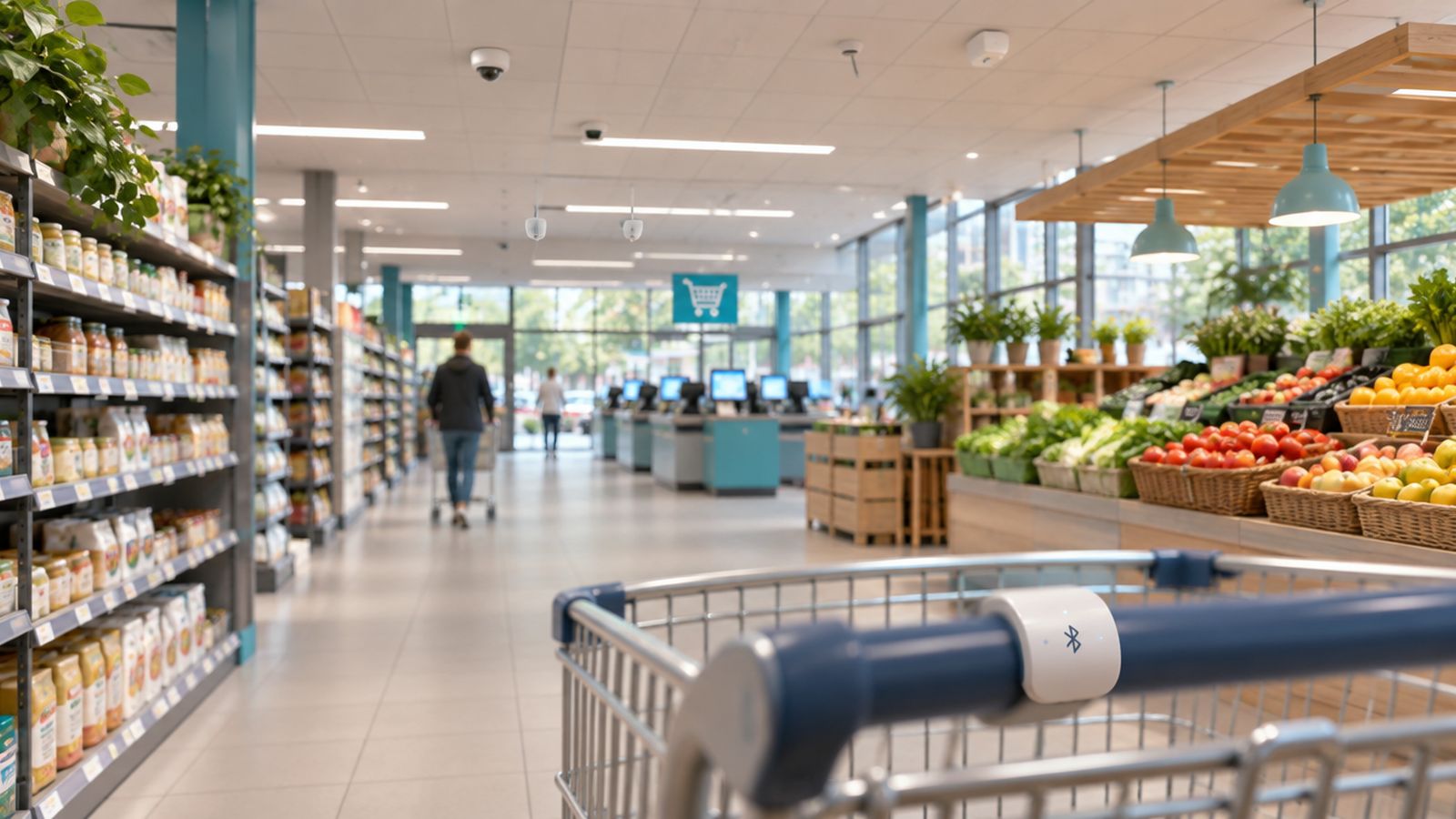
| Which aisles do shoppers visit or skip, where do they stop, and what do they buy? | Bluetooth tags on trolleys and baskets, located by ceiling antennas and matched with receipts | Full anonymous path from entrance to till, stops, engagement, cross-category trips, conversion per bay | No app, no cameras, no personal data. Fits supermarkets and hypermarkets. Does not capture shoppers who carry nothing and gives no images of the shelf. |
| How do flow and queues behave in one priority zone? | Targeted 2D or overhead cameras | Continuous flow, queue length, occupancy in a defined area | Accurate where they look. Covering a whole regular supermarket can take hundreds of units, with higher privacy requirements. |
| What happens exactly at one key bay or promotion? | 3D stereo cameras at specific interaction points | Precise zone counts, dwell and interaction at the bay | High detail for a small area. Best on a few bays that matter, not across the ceiling. |
| Is the product there, and is it fresh? | RFID, shelf images, digital shelf labels | Item-level availability and inventory | Answers operations questions. Does not show shopper behaviour. |
| Did the trip end in a purchase? | POS and receipt data | What was bought, basket and mission | The outcome of every trip. On its own it cannot explain the path that led there. |
Bluetooth tags on trolleys and baskets are different from the old app-based beacons. Beacons needed shoppers to download and run an app, which is a big reason they did not work out. Tags sit on the shopping tool, so the shopper does nothing and nobody is identified. Our comparison of in-store analytics technologies covers the history.
Cameras and trolley tracking answer different questions. A camera sees what is in its field of view, such as a shelf or a queue. A tag on a trolley follows the full anonymous trip and links it to the ticket. See how cameras and trolley tracking compare, and why a people counter or Wi-Fi tracking answers yet another question.


